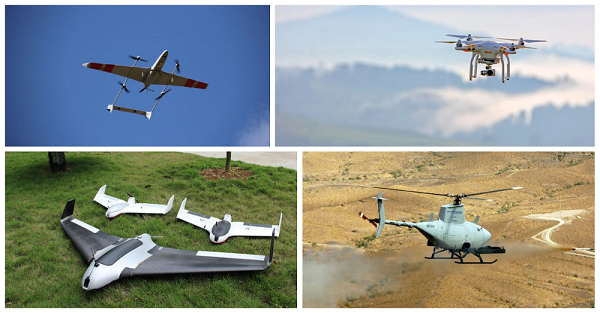
Drones are widely used to serve various purposes in industry, mapping, and crisis management. However, the use of drones is increasing in important places such as airports, power plants, and important buildings, endangering public safety and causing problems with aircraft. For this reason, it is very important to detect and recognize them accurately and quickly to prevent security problems caused by unauthorized access to critical infrastructures. In this project, a novel and accurate technique based on deep learning networks is presented to detect and recognize 4 types of flying drones in visible images and differentiate them from birds using a set of 26,000 normal visible images.
Drone Detection & Recognition Challenges
Different weather conditions and crowded background.
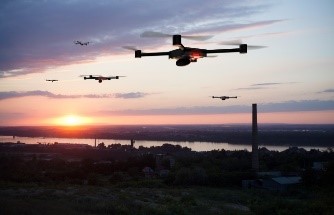
Problems such as the presence of drones in crowded environments and different lighting conditions make drone detection difficult.
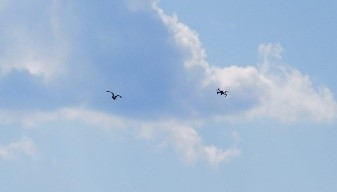
The resemblance of drones and birds.
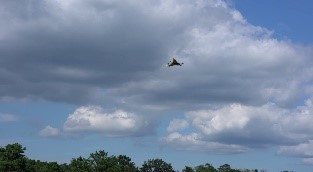
Drones can be mistaken for birds, especially at long distances, because of their similar-ity in behavior and physical characteristics.
Lack of Scalability.
The presence of drones at close and distant distances challenges to accurately detect and recognize different types of drones.
Small size of drones at long distances.
The presence of drones at long ranges makes them smaller and causes problems in detection and recognition.
METHOD
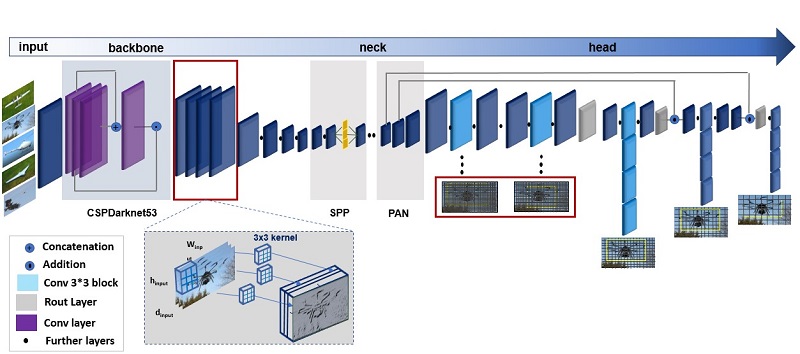
This network can solve the challenges of detection and recognition in visible images, such as crowded backgrounds, the presence of hidden areas, and problems related to the small size of drones. The basis of this method is the YOLOv4 Deep Learning network, which has achieved better results by making changes to the architecture of this network.
Diagram
RESULTE
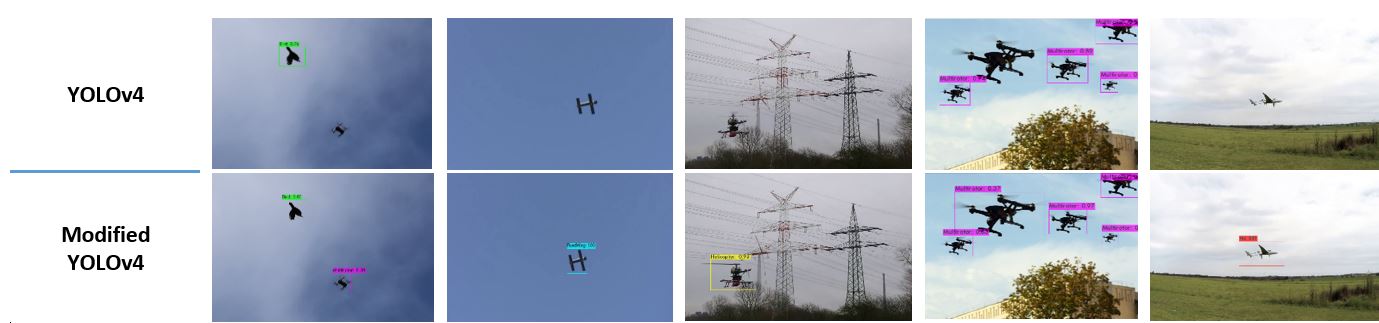
In this study, the modified YOLOv4 is used to improve the detection and recognition results of 4 types of drones and birds concerning the existing challenges such as the smaller size of the drones, crowded backgrounds, lack of scalability, and similarity with birds. In this study, the modified YOLOv4 is used to improve the detection and recognition results of 4 types of drones and birds concerning the existing challenges such as the smaller size of the drones, crowded backgrounds, lack of scalability, and similarity with birds. Fig. 19 shows the performance of both basic and modified models in overcoming the challenges. The following figure shows the performance of both basic and modified models in overcoming challenges.



No comments