AUTONOMOUS UNDERWATER VEHICLE
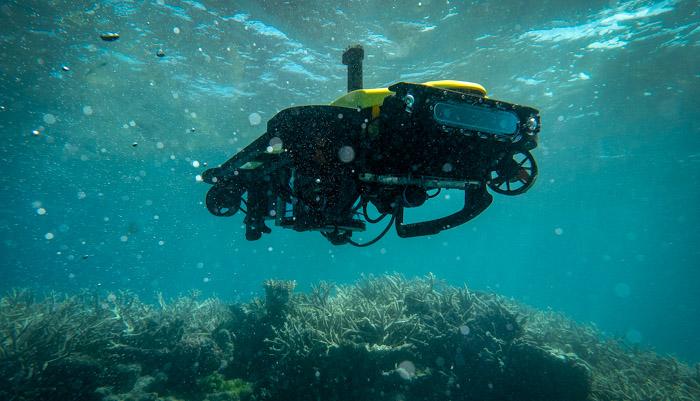
An Autonomous Underwater Vehicle (AUV) is a free-swimming, untethered robot under the control of an onboard computer. AUVs can be thought of as computer-controlled taxicabs for a wide range of sensors.AUVs are battery powered. Small AUVs can deploy for several hours, while large vehicles can swim for several days. Survey speeds are usually 2-4 miles per hour (1 - 2 meters/second), chosen to maximize range for the onboard battery power. Many vehicles are capable of surveying to continental-shelf depths, with a few capable of full ocean depth.
The main AUV features
AUVs can gather data with sufficient resolution in time and space to provide an understanding of nature’s dynamics. AUVs are well-suited to carry out swathe mapping (detailed 3-D mapping of the seabed using sonar), and large-area surveys. They can carry multiple payloads, allowing synoptic coverage; for example an AUV may simultaneously image the seafloor while measuring water quality. AUVs routinely carry fluorometers, turbidity and turbulence sensors, magnetometers, and water-quality sensors. It is deployed in the oil and gas industry to make maps of the seafloor. The military also uses it for inspection and identification. This has aided commerce and security in many nations.
Application
The design of autonomous underwater vehicles make it very stable and agile. AUV is designed like a torpedo, with a propulsion system consisting of one or two thrusters. It also has control surfaces which are in charge of controlling the movement of the vehicle. It is structured with a streamlined fairing which reduces hydrodynamic drag; and a pressure haul which houses power electronics. Low Deployment Cost: Autonomous underwater vehicles do not need a bulky, and complex support system. They carry their own energy source, and as such do not need external power. The absence of external control also reduces the operational cost of employing a human operator.
Unlike other unmanned vehicles such as ROVs, AUVs work without control from an operator. This, therefore, makes it faster, increasing its data-to-signal ratio. This makes surveys faster and more accurate.