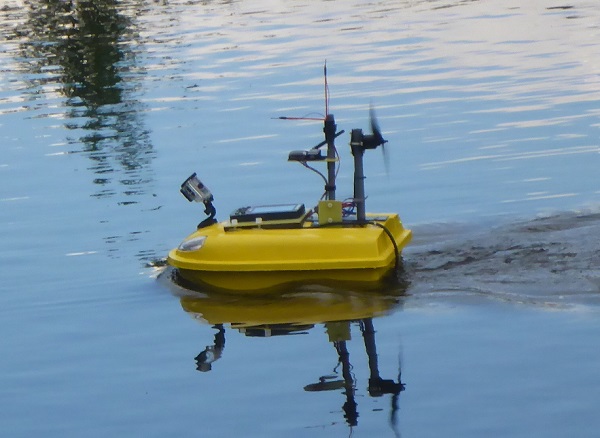
UNMANNED SURFACE VEHICLE
The Unmanned Surface Vehicles (USV) or Autonomous Surface Vehicles (ASV) are vessels that operates on the water surface without any crew. They are remotely controlled and can be controlled by an operator located on land or on board of another vessel. Thereby maintaining a first line of defense or perform inspections of other ships, etc… while manned boats are kept at a safe distance, avoiding unnecessary risks.
The main USV features
USV are valuable for oceanographic applications, as they are more useful than the weather buoys, but more cost-effective than the weather ships or equivalent research vessels, and more adaptable than commercial vessels. With them you can make bathymetry, exploration and mapping of the marine funds, and can make tracking of large mammals for biological studies. There are USV that are powered by the energy of the waves and from their solar cells, achieving to have months of maritime autonomy.
Application
The USV are usually resistant, stable, stealthy, fast and highly maneuverable; normally its main military application is act as maritime mobile target for military training and for tests of defense systems. But they have a wide variety of applications such as protection forces, anti-piracy forces, anti-terrorism forces, surveillance and reconnaissance, electronic warfare and mining. In these additional applications, USV offer greater capacity for surveillance, identification and interception compared to traditional systems. It can be equipped with stabilized weapons systems, with surveillance systems and electro optical tracking systems capable of monitoring both day and night by using infrared vision.